Sourcing & manufacturing · 12 min read · 24 September 2026
How international buyers source decorative, hospitality and contract lighting from India — the manufacturing clusters, custom development, factory verification, quality control and export packaging, end to end.
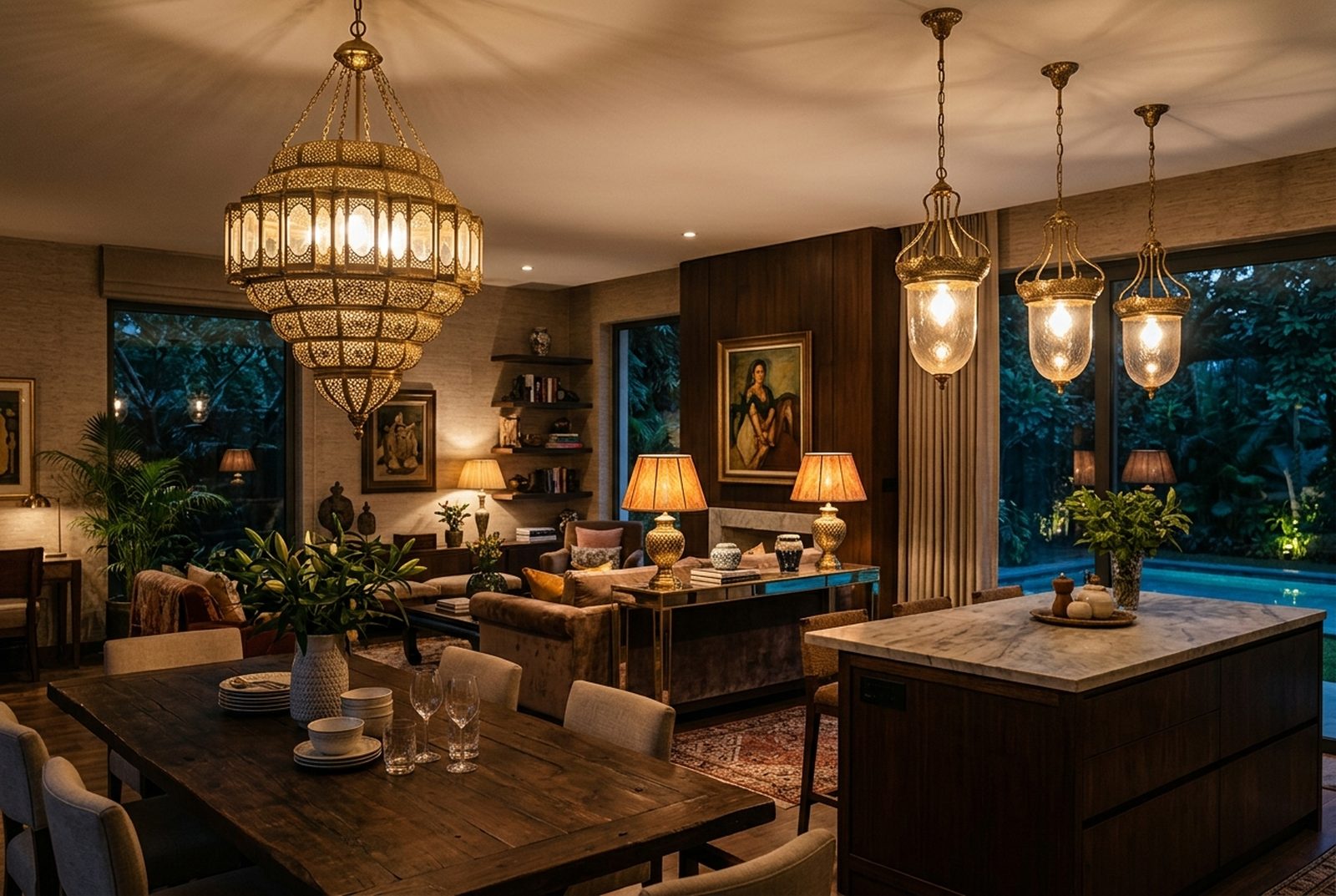
India is one of the world's three great decorative-lighting manufacturing geographies, and for international buyers it is increasingly the first call rather than the alternative. Brass chandeliers and pendants from Moradabad, hand-blown glass shades from Firozabad, lamp-holders and hardware from Aligarh, ceramic lamp bases from Khurja — four specialist clusters within a 200-kilometre band of western Uttar Pradesh, consolidated into destination-compliant finished goods at Delhi NCR assembly units.
This guide is the working playbook we give buyers starting their first Indian lighting programme: where each category is actually made, how custom development runs, how to verify a factory before you place a purchase order, what quality control should look like on an electrical product, and how export packaging protects fragile glass and polished brass across a 25-day ocean voyage.
Why international buyers source lighting from India
Three structural advantages drive the decision. First, cost: Indian decorative lighting lands 25-45% below European-manufactured equivalents at comparable quality tier, driven by labour-intensive handcraft stages that automation has not replaced. Second, craft depth: Moradabad's brass workshops carry five-generation hand-casting, spinning, embossing and patination lineages that simply do not exist at scale anywhere else. Third, flexibility: Indian factories accept MOQs from 50-300 units per SKU on chandeliers and 300-1,000 on table lamps — dramatically lower than Chinese mass-production lines — which suits the test-and-repeat rhythm of modern retail and DTC.
- Decorative retail lighting — table lamps, floor lamps, wall sconces, pendants and chandeliers for US, UK and EU home retailers
- Hospitality FF&E lighting — guestroom, lobby and restaurant lighting packages for hotel brands and design firms
- Contract and architectural lighting — project-scoped programmes for restaurant groups, offices and design-build firms
- OEM and private-label — buyer-designed collections manufactured exclusively for one brand
India's Major Lighting Manufacturing Clusters
Indian lighting is not one industry — it is four specialist cluster economies that combine inside a single finished product. Understanding which cluster does what is the foundation of every successful sourcing programme.
Moradabad: brass and metal lighting
Moradabad's brass-working tradition dates to the 18th century. Today the cluster runs roughly 6,000 workshops and factories — from single-artisan chisel studios to export-scale Tier-1 factories with in-house casting, CNC, spinning, buffing and lacquering. Standard brass grades include 63/37 yellow brass for decorative work and 90/10 red brass for premium finishes. Antique brass, brushed brass, blackened brass and hand-applied patina finishes are cluster-standard. This is where the structural metal of most Indian decorative lighting is born.

Firozabad: Glass Manufacturing
Firozabad has been India's glass city for two centuries. Around 400 glassworks produce hand-blown clear, seeded, ribbed, tinted and cased-glass shades alongside machine-pressed glass for higher-volume programmes. For buyers, two disciplines matter here: tint consistency (hand-blown batches vary; multi-shade pendants need Delta E ≤3 batch matching) and thermal integrity (shades for enclosed fixtures must pass heat-soak testing). Both are verified at pre-production inspection.

Aligarh, Khurja and Delhi NCR
Aligarh supplies the hardware layer — E12/E14/E26/E27 lamp-holders, cord-grips, switches and wiring. Khurja produces hand-glazed ceramic lamp bases. Delhi NCR is where everything converges: final assembly, wiring to destination spec, plug fitting (NEMA for the US, BS 1363 for the UK, Schuko for the EU), electrical-safety testing coordination, and export consolidation. A single pendant lamp can carry work from all four clusters — which is exactly why buyers use a sourcing partner rather than managing four supplier relationships directly.
Custom Lighting Development
Custom development is where Indian lighting sourcing earns its premium reputation. The workflow: the buyer supplies a CAD file, a reference photograph or a physical sample; our product-development desk translates it into a technical spec-sheet with material grades, finish callouts, wiring diagram and compliance targets; the factory produces a first physical sample in 25-40 days (60-90 days for custom-scale chandeliers above one metre diameter); one round of paid revision follows; then the production purchase order is locked.

For hospitality FF&E and architectural contract programmes we run formal sample-room construction — one or two physical guestroom or public-area mock-ups built at the factory for the operator's or designer's sign-off before mass production begins. Tooling investment, where required, is amortised across the production run or invoiced separately — the buyer's choice, documented in the tech-pack.
Factory Verification Before Ordering
Every lighting factory we place a programme with passes a four-layer verification before a purchase order is signed. First, compliance documentation: a current BSCI or Sedex social audit, plus an established testing partnership with TÜV, SGS, Bureau Veritas or Intertek. Second, a physical technical audit: our field team walks the workshop inspecting casting quality, finishing consistency, wiring discipline and packaging lines. Third, financial standing: registration, GST filing status and 24 months of export shipment history. Fourth, references: two or three current international buyers contacted directly.

Factories that fail any layer are not shortlisted. This filtering is the single most valuable step in the whole programme — it is far cheaper to reject a factory at verification than to reject a container at destination.
Quality Control for Lighting
Lighting is an electrical product, and quality control goes beyond appearance. Our four-stage inspection framework covers pre-production (raw-material and pre-production-sample verification), during-production inspection at 30-50% completion, and pre-shipment inspection to AQL 2.5 sampling — where every sampled unit passes electrical-safety verification: continuity, insulation resistance (≥100MΩ at 500V DC), dielectric withstand and earth continuity on Class I luminaires. Every single unit, not just samples, gets a functional bulb-on test. Critical defects — exposed live parts, missing earth, wrong wiring gauge — have zero tolerance and fail the batch outright.

Finish inspection runs in parallel: brass lacquer coverage, patina consistency across the batch, glass shade clarity and tint-matching, ceramic glaze integrity, and dimensional verification against the approved tech-pack. Destination labelling — wattage, voltage, safety warnings and the CE / UKCA / cUL mark placement — is verified on the finished carton, not assumed.
Packaging for Export Lighting
A hand-blown glass shade survives the furnace, the annealing lehr and the workshop — and then faces 25 days in a shipping container. Export packaging for lighting is engineered, not improvised: each glass shade sits in a custom-cut foam cradle, brass surfaces get foam-block separation and anti-tarnish wrap, individual cartons carry corner protectors, and master cartons are double-wall with silica-gel moisture control for humid routes. Random cartons from every batch are drop-tested at pre-shipment inspection.

Container loading is supervised on camera: fragile cartons loaded top-tier, dunnage between layers, seal number recorded, and the loading photographs filed with the shipment documentation. Buyers receive the full evidence pack before the vessel sails.
Frequently asked questions
What is the MOQ for lighting sourcing from India?
Table lamps 300-1,000 units per SKU, wall lights 200-800, floor lamps 100-500, chandeliers 50-300 depending on complexity, pendants 300-1,000. Hospitality FF&E is project-scoped — typically 60-400 guestroom lighting packages per property. Tier-3 specialty workshops accept 50-500 units for craft-heavy designs.
How long does a lighting programme take from India?
Sample development runs 25-40 days for standard custom designs (45-60 days for hand-blown glass, 60-90 for custom-scale chandeliers). Production runs 45-75 days depending on category and volume. Ocean freight adds 22-32 days depending on destination port. A first-programme buyer should plan for a five-to-seven month concept-to-warehouse timeline; repeat programmes compress to three-to-four months.
Which electrical certifications can Indian lighting carry?
cUL or UL 153/1598 for the United States, UKCA with BS 1363 plugs for the United Kingdom, CE with EN 60598 and GS-mark for Germany and the EU, NF for France, and RCM with AS/NZS 60598 for Australia. Testing is coordinated through TÜV Rheinland, SGS, Bureau Veritas or Intertek partnerships at the Delhi NCR final-assembly stage, and certificates are handed to the buyer at purchase-order stage.
Can Asia Sourcing develop my own lighting design in India?
Yes — custom development from CAD, reference image or physical sample is a core service. First physical samples run 25-40 days, one paid revision round is included, and OEM private-label branding on product and packaging is standard. Design IP is protected under NDA with the factory and exclusivity terms are written into the production agreement.
Start Sourcing Lighting from India

Whether your programme is twelve boutique pendants for a design shop or a 400-room hotel FF&E package, the route is the same: a written brief, a verified factory shortlist, physical samples, milestone-linked inspection and a supervised container. Send us the category, the target price and the destination — we will return a factory shortlist and a costed programme plan within five working days.
Ready to source?
Looking to Source from India?
Whether you're developing a new collection or looking for reliable manufacturing partners, our sourcing experts are ready to help.
Stay updated with industry insights
Monthly sourcing updates, market trends, and supply-chain insights.
Receive monthly sourcing updates, market trends, product innovations, and supply-chain insights directly from Asia Sourcing India.