Sourcing & manufacturing · 8 min read · 14 January 2026
The China-plus-one strategy is now standard practice for global buyers. What's driving the shift, what risks it addresses, and why India is the primary beneficiary.
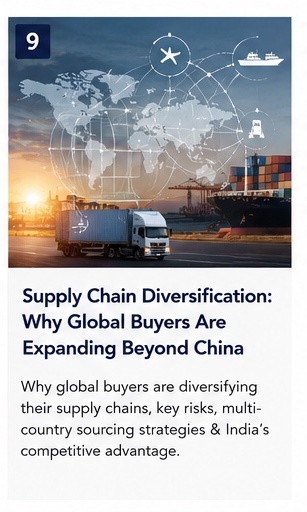
Supply chain diversification — the 'China-plus-one' strategy — has moved from executive-boardroom conversation to standard operating procedure at every retail buyer we work with. Here's what's driving the shift and what it means for sourcing programmes.
What triggered the shift
Three convergent forces triggered mass diversification away from single-source China sourcing. First, the 2018-2019 US-China tariff cycle raised landed costs 15-25% on many home décor and consumer categories, resetting the maths that had made China the default choice for 25 years. Second, the 2020-2021 pandemic-era port congestion exposed the operational risk of single-country reliance — factories closed, containers stranded, retail programmes delayed by 4-8 months at critical seasons.
Third, and now the most durable driver, is geopolitical concentration risk. Investor and board-level pressure on Fortune 500 retailers to demonstrate supply-chain resilience has moved from optional to mandatory. Every major US and EU retailer is now expected to have a documented multi-country sourcing strategy; supplier concentration above 60% in any single country is now a red-flag governance issue.
The China-plus-one countries — who's winning share
Diversification share has flowed to specific countries by category. Vietnam captured most of the electronics and technology assembly transition. Bangladesh gained apparel and textile share. Mexico gained automotive-adjacent share (nearshoring). India has been the primary beneficiary in home décor, handicrafts, textile, furniture, leather, and mid-tech consumer goods — the categories where craft depth, English-language operational language, and demographic scale all favour India specifically.
For sourcing programmes covering categories in this profile, India-first diversification is the most common answer. For categories that require the assembly-line scale and technology density of Chinese mega-factories (higher-end electronics, precision components), Vietnam or Malaysia are typical answers.
India's structural advantages
India has three structural advantages that are unusually durable. First, demographic scale: 1.4 billion population, 65% under age 35, and a growing manufacturing workforce that will remain cost-competitive for the next 15-20 years. Second, English-language operational capability: nearly every export factory operates in English, dramatically reducing communication overhead versus Vietnam, Bangladesh or Cambodia.
Third, and most distinctive, is craft cluster depth: 400+ years of continuous artisan tradition in brass (Moradabad), marble inlay (Agra), wooden carving (Saharanpur), carpet weaving (Bhadohi), textile (Panipat, Varanasi) and pashmina (Kashmir). This is not manufacturing infrastructure that can be replicated in Vietnam or Mexico within a generation — it's a cultural asset with legal GI protection.
The risks that remain in India sourcing
Diversification to India is not without residual risk. Infrastructure quality lags China: port congestion at Nhava Sheva during peak season, unreliable rural power supply affecting factories outside major clusters, and slower inland trucking than Chinese equivalents. Documentation overhead is higher — LEC, GSTN e-invoicing, RoDTEP paperwork adds administrative load.
Quality control discipline is more variable than China's high-volume factory tier — India's cluster geography means artisan variance is real. This is precisely why buying-agent representation on the ground (our role) matters more in India than in China. The workaround for variance is not eliminating variance but disciplined QC oversight, which we build into every programme.
Practical playbook for 2026
For buyers considering India-first diversification, the standard playbook: (1) Start with one category and one Indian cluster — get the operational rhythm working before diversifying further. (2) Run parallel China and India programmes for 12-18 months to compare landed-cost, quality-variance and lead-time reliability. (3) Set a 3-year target for the India share (typically 30-50% of the category by year 3). (4) Invest in relationship depth with your Indian buying agent — this is where the operational win lives.
The single most important variable is finding the right supplier tier. Our supplier network has been curated over 23 years specifically for export-programme reliability; the retail buyers we work with typically hit their India-share targets 12-18 months earlier than internal benchmarks. This is not accidental — it's what dedicated buying-agent representation delivers.
Ready to source?
Looking to Source from India?
Whether you're developing a new collection or looking for reliable manufacturing partners, our sourcing experts are ready to help.
Stay updated with industry insights
Monthly sourcing updates, market trends, and supply-chain insights.
Receive monthly sourcing updates, market trends, product innovations, and supply-chain insights directly from Asia Sourcing India.