
Sourcing & manufacturing · 8 min read · 18 January 2026
India is the world's third-largest furniture exporter. What buyers should know about the Jodhpur, Saharanpur and Panipat manufacturing clusters, material choices and OEM capability.
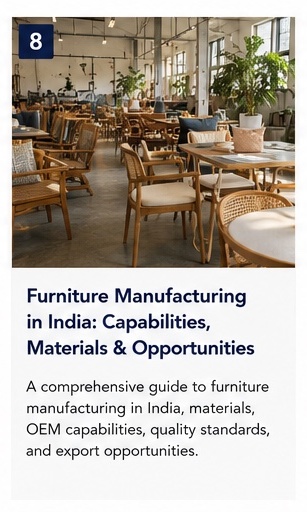
India is the world's third-largest furniture exporter and the fastest-growing supplier tier to US, EU and Middle Eastern retail. Here's what makes India distinctive as a furniture sourcing geography.
The three major manufacturing clusters
Furniture production in India is concentrated in three geographically distinct clusters, each with its own material and technique specialisation. Jodhpur (Rajasthan) — the largest — specialises in solid-wood furniture with hand-carved detail, iron overlay work and princely-era heritage aesthetics. Sheesham (Indian rosewood) and mango wood dominate the material mix. Jodhpur has 5,000+ registered manufacturers and hosts India's largest annual furniture buyer trade fair.
Saharanpur (Uttar Pradesh) is India's GI-tagged wood-carving capital — deep-relief hand carving on sheesham, mango and acacia. The output is design-forward, artisan-heavy and mid-to-premium price point. Panipat (Haryana) is the specialist for upholstery-heavy furniture, dining sets and industrial-scale contract manufacturing — the modern automated end of India's furniture capability.
Materials — solid wood, engineered wood, mixed-material
The material split in Indian furniture export is unusual by global standards. Solid sheesham and mango wood dominates volumes — India is one of the few sourcing geographies where solid tropical hardwood furniture is genuinely economical at retail price points. Solid teak and acacia round out the natural-material mix.
Engineered wood (particle board, MDF, plywood) programmes are also available and increasingly popular for flat-pack DTC brands. Iron-and-wood mixed-material furniture (industrial-heritage aesthetic) is a Jodhpur specialty. Marble-topped tables (Agra and Rajasthan marble sources) integrate cleanly with our furniture programmes for hospitality clients.
OEM capability, sampling and custom design
Indian furniture factories are highly OEM-fluent. Custom-designed collections from client CAD drawings are routine offerings; prototype sampling typically runs 15-30 days from approved sketches to production-approved sample. Bespoke commissioning at single-piece MOQ is accepted for hotel and interior-design projects — a capability that Chinese and Vietnamese equivalents typically cannot match economically.
For DTC and specialty retail brands, our supplier tier runs iterative development cycles: initial concept sketches → first physical sample → design refinement → PP sample approval → bulk production. This process is design-collaborative rather than purely price-competitive — appropriate for brands whose retail-shelf story rewards distinctive design language.
Quality, certifications and finish discipline
Quality control on furniture is heavily process-dependent. Kiln-drying to 10-12% moisture content is our default spec (5-8% below Indian ambient equilibrium for destination-climate acclimation buffer). Every joint is stress-tested; every finish is 96-hour humidity-cycling verified. AQL 2.5 general on cosmetic defects; tighter AQL 1.0 on structural components.
Certifications available: FSC chain-of-custody on wood species; BSCI and Sedex social-compliance audit on factories; FIRA (Furniture Industry Research Association) durability certification for hospitality-programme buyers requiring commercial-grade performance. GOTS certification available on upholstery cotton fabric for buyers with organic-materials programmes.
MOQ, lead times and freight economics
MOQ starts at 100 pieces per SKU for stock designs (mid-market volumes) or 50 pieces for OEM development work (design collaboration). Lead time is 60-90 days from PO to FOB depending on complexity and finish. Container yield ranges 40-80 pieces per 40-ft container for standard chair sets; 12-24 pieces per 40-ft for larger dining sets and bedroom furniture.
For programmes below single-container volume, LCL consolidation through our Delhi hub is often the correct economic answer. Freight rates to US East Coast: $2,800-$3,400 per 40-ft container in Q1 2026. To Northern Europe: $2,000-$2,600. Air freight is generally uneconomical on furniture given weight-to-value ratio.
Ready to source?
Looking to Source from India?
Whether you're developing a new collection or looking for reliable manufacturing partners, our sourcing experts are ready to help.
Stay updated with industry insights
Monthly sourcing updates, market trends, and supply-chain insights.
Receive monthly sourcing updates, market trends, product innovations, and supply-chain insights directly from Asia Sourcing India.