Sourcing & manufacturing · 9 min read · 8 January 2026
From concept sketch to first container — the step-by-step OEM development playbook for brands launching private-label ranges from India.
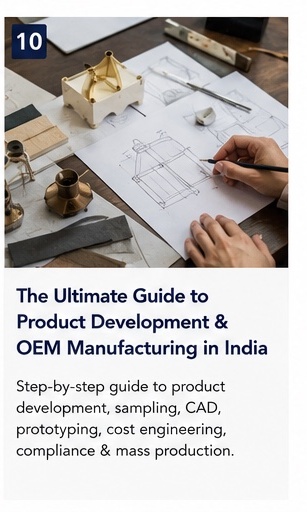
Original Equipment Manufacturing (OEM) — where a factory produces goods to a buyer's design and specification, sold under the buyer's brand — is the workhorse commercial model for retail programmes sourced from India. Here's the step-by-step playbook from concept to first container.
Step 1 — Concept brief and design sketches
OEM development starts with a design brief. This is not a formal document — a Pinterest board, mood-board of reference images, and a short written summary of the target retail positioning, price point, MOQ target and destination market is usually enough to kick off supplier conversation. Detailed measurements come later; the design intent comes first.
For buyers who arrive with fully-developed CAD files and technical drawings, sampling is faster (immediate PP sample production). For buyers arriving with only mood boards, our design team collaborates on the sketch-to-drawing translation — an added 10-15 days upfront but common for smaller DTC brands who don't have in-house CAD resources.
Step 2 — First physical sample
The first physical sample is the design-review checkpoint. Typical turnaround is 15-30 days from approved sketches to received first sample; complex mixed-material pieces may take 45-60 days. The first sample almost never matches expectations perfectly — expect 2-3 iterations of dimension adjustment, finish refinement and material substitution before landing on a PP (pre-production) approved sample.
Cost engineering happens in parallel with sample development. Our buying office negotiates against target unit price at every iteration — 'this hinge specification adds $0.85 per unit; here's the alternative at $0.35 with acceptable durability trade-off'. This transparency is what separates buying-agent representation from pure sourcing-broker service.
Step 3 — PP (pre-production) sample approval
The PP sample is the contractual reference for the entire production run. Every specification is locked at PP sign-off: material, finish, dimensions, weight, packaging, labelling, hangtag copy, master-carton spec. Our supplier tier issues a formal PP Sample Approval document that both buyer and factory sign; deviations from this reference during production are inspection failures.
The PP sample also anchors the retail-shelf conversation. High-quality PP samples support pre-selling to retail buyers before mass production — a workflow that materially de-risks capital exposure on first-time programmes. Our design team routinely produces additional 'buyer sample' units (5-10 pieces) specifically for retail trade-show and buyer presentation use.
Step 4 — Bulk production and in-line QC
Bulk production runs 30-45 days for standard programmes; 60-90 days for complex multi-material collections. In-line QC checkpoints run at 20% completion (raw material and initial assembly verification), 60% completion (finish and assembly integrity) and 100% completion (final inspection before packing). Our in-house QC inspectors visit factory sites weekly during bulk production.
The most common bulk-stage failure is material substitution — factory attempting to use lower-grade material than PP spec. This is caught at the 20% checkpoint and reversed before it becomes a shipment-level problem. The frequency of these attempted substitutions is why on-ground buying-agent representation matters; remote email-only supervision does not catch this reliably.
Step 5 — Third-party pre-shipment inspection
Before container loading, an independent third-party inspection (SGS, Intertek, QIMA or Bureau Veritas) runs formal AQL sampling against agreed protocols. Standard is AQL 2.5 general defects and AQL 1.0 critical defects. Our supplier tier passes this inspection on the first pass 92%+ of the time; the 8% of cases requiring re-work are always caught before shipment leaves India.
Third-party inspection is a fixed cost ($400-$800 per container) but it's the risk-transfer mechanism that lets buyer accept the shipment against Letter of Credit or open-account payment. It's rarely worth skipping.
Step 6 — Container loading and export documentation
Container loading happens under our Delhi consolidation supervision. Every container is photographed at multiple stages, sealed with a serial-numbered container seal, and manifested with a bill of lading, commercial invoice, packing list and destination-market-specific compliance documents (CE, FDA, LFGB, REACH declarations as applicable).
Total time from PO confirmation to FOB (loaded on vessel at port) is typically 60-90 days for OEM programmes. For repeat buyers on established SKUs, reorder-to-FOB drops to 40-50 days since design and sampling are already complete.
How this compares to buying stock designs
OEM development is meaningfully more work than buying supplier-stock designs. The premium is time (60-90 days versus 30-45 days) and one-time development cost (typically 5-15% of programme unit price is absorbed into first-run OEM economics). The reward is retail-shelf differentiation, brand-authored design language, and margin control on repeat programmes.
For DTC brands and specialty retailers whose retail narrative is design-forward, OEM is the correct model. For mass-market buyers optimising unit cost above all else, buying supplier-stock designs is often the better economic answer. Both models are supported through our supplier network.
Ready to source?
Looking to Source from India?
Whether you're developing a new collection or looking for reliable manufacturing partners, our sourcing experts are ready to help.
Stay updated with industry insights
Monthly sourcing updates, market trends, and supply-chain insights.
Receive monthly sourcing updates, market trends, product innovations, and supply-chain insights directly from Asia Sourcing India.