Sourcing & manufacturing · 6 min read · 5 February 2026
A visible shift from annual retail programmes to quarterly reorder cycles. India's craft cluster geography uniquely enables this — here's why.
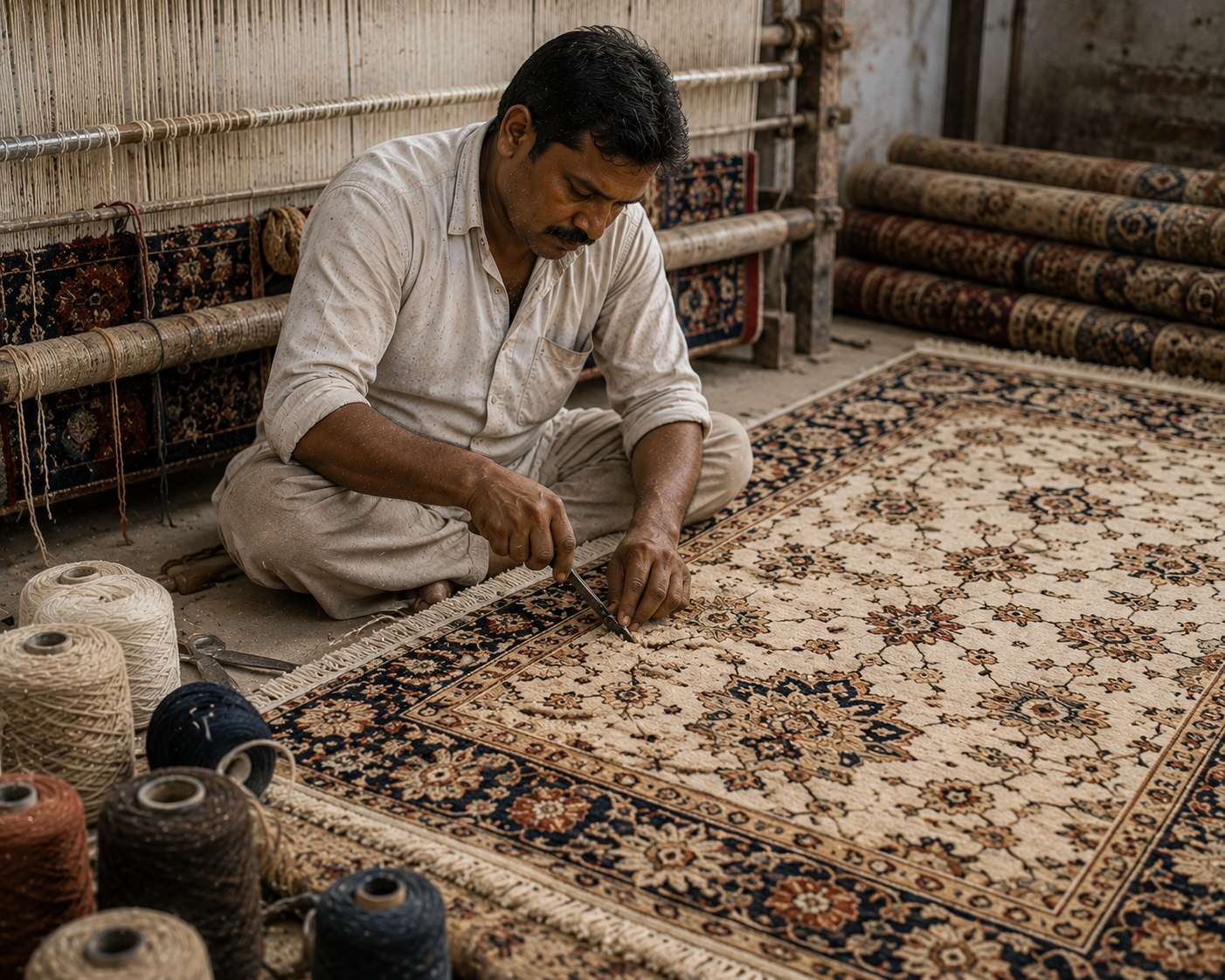
A visible shift in retailer buying behaviour: annual programmes are being replaced with quarterly reorder cycles. This is dramatically changing the sourcing calendar and the capability set that suppliers need to survive.
The old rhythm — one big order per year
For twenty years, the retail-programme rhythm was single-annual: buyer places one large purchase order in Q1 for AW delivery, or Q3 for SS delivery. Container quantities were large (multi-40-ft), margin conservative, SKU commitments locked at buy-time. Suppliers valued volume and consistency; agility was not required.
The rhythm suited China's mega-factory model perfectly — high volume per SKU, predictable capacity planning, long amortisation of tooling investments. It also suited traditional 3-tier retail (wholesaler → distributor → retailer) with 6-month inventory turnover.
The new rhythm — quarterly reorders
DTC brands and specialty retailers now operate on quarterly reorder cycles. Initial launch order is smaller (500-2,000 pieces per SKU), retail-shelf performance is observed for 6-8 weeks, and successful SKUs are reordered in 6-12 week cycles. Unsuccessful SKUs are dropped after a single cycle.
This shift is driven by capital efficiency (holding less inventory), retail-shelf agility (responding to what's actually selling), and Instagram-native brand narratives (novelty and rotation matter more than seasonal consistency). Amazon and Etsy have accelerated the pattern.
Why India uniquely enables this
The old rhythm favoured China; the new rhythm favours India, and specifically favours India's craft-cluster geography. Small-batch handicraft production is India's default state. A Moradabad brass foundry can economically produce a 500-piece run; a Chinese equivalent typically cannot below 5,000.
India's cluster structure also enables SKU rotation without new tooling. A brass foundry that produces one candle-holder shape this quarter can produce a modified variation next quarter without amortising new tooling — the artisan simply works from a modified drawing. This is impossible in a Chinese die-casting factory where new tooling costs $5,000-$50,000 per SKU.
What this means for buyers and suppliers
Buyers gain three advantages: faster response to retail signals, lower inventory holding costs, and higher SKU rotation supporting Instagram-native brand narratives. Suppliers who can operate this rhythm gain: higher margin per unit (small-batch pricing supports it), longer retention (successful SKUs reorder repeatedly), and reduced dependence on any single retailer.
The supplier capability that matters is not manufacturing scale but manufacturing agility — the ability to run 500 pieces of SKU-A this month, 500 pieces of SKU-B next month, with minimal changeover cost. Our supplier tier is explicitly optimised for this rhythm; agility is not an afterthought.
Practical guidance for programme buyers
For buyers considering the shift: start with a 6-SKU curated collection at 500-1,000 pieces per SKU. Observe retail performance for 6-8 weeks. Reorder the 3-4 successful SKUs at 1,500-3,000 pieces, drop the underperformers. Then commission new SKUs to replace the drops. Rotate the collection quarterly. This is our recommended playbook for DTC brands entering the India-sourcing programme.
Ready to source?
Looking to Source from India?
Whether you're developing a new collection or looking for reliable manufacturing partners, our sourcing experts are ready to help.
Stay updated with industry insights
Monthly sourcing updates, market trends, and supply-chain insights.
Receive monthly sourcing updates, market trends, product innovations, and supply-chain insights directly from Asia Sourcing India.