Design & product trends · 6 min read · 27 February 2026
Six visible shifts in international home décor buying — from the return of hand-hammered brass to the rise of GI-tagged marble inlay and small-batch artisan glass.
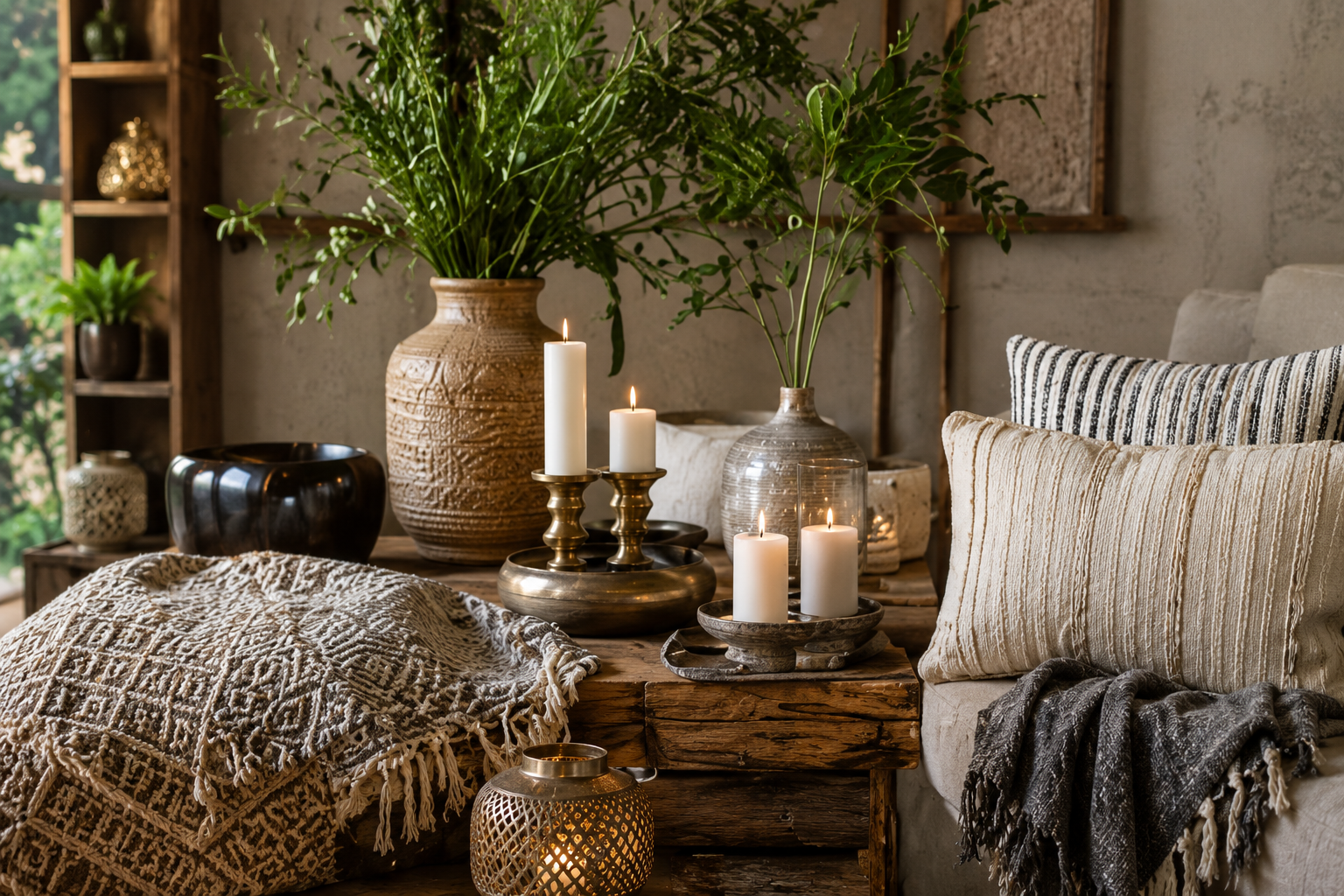
Six visible shifts in international home décor buying we're tracking through the current year. All six are meaningfully changing the SKU mix on our supplier lines — which is the only trend indicator worth writing about.
1. Earth-tone brass is replacing bright polished brass
The last five years of mainstream brass décor were dominated by high-shine mirror-polished finishes. That's now cooling. Buyers are increasingly requesting warm antique-brass patina, hand-hammered dulled finishes and specialist verdigris programmes. Our Moradabad foundries are running these finishes at a 40% higher rate than 2024, and retailer sample requests overwhelmingly favour warmth over gloss.
Practical implication: if you're placing a private-label brass programme, brief the finish spec early. Bright mirror-polish is faster to produce; antique patina takes an additional 3-5 days per SKU and cannot be back-shifted in a peak-season programme.
2. Hand-hammered aluminium is the new brass alternative
For buyers who love the look of hammered brass but need freight economics that work for large-format planters and garden pieces, hand-hammered aluminium has emerged as the 2026 sleeper hit. 65% lighter than brass, anodised in 400+ colours, and impossible to distinguish from brass at retail-shelf distance.
Container yield on aluminium planters runs 2-3x higher than brass equivalents, meaning per-unit freight drops 40-60%. For volume retail programmes this is meaningful margin. Our Moradabad aluminium spinners are quoting 8-week lead times on new tooling versus 12 for brass — another practical advantage.
3. The marble inlay revival — pietra dura crosses over to mainstream
Agra's pietra dura marble inlay — the exact craft that built the Taj Mahal in the 1630s — has traditionally sat in the luxury-only channel. In 2026 we're seeing something new: mid-market retailers (Anthropologie, Zara Home, Made.com) commissioning simplified inlay coasters, small trays and jewellery boxes at retail price points around $30-$80. Volume has doubled year-on-year.
This is a genuine artisan-craft crossover moment. GI-tagged provenance documentation — showing the piece was made in the registered Agra GI district — is now table stakes for these retail programmes, and pushes the retail-shelf story from decorative to heritage. Buyers who commission early lock in the good artisan capacity before the H2 rush.
4. Small-batch artisan glass — Firozabad returns to fashion
Firozabad — India's Glass City — has been dominated by high-volume commodity glass for two decades. Small-batch, characterful, deliberately-irregular hand-blown glass is now returning to fashion, driven by hospitality (boutique hotels, indie restaurants) and DTC brands (Etsy sellers, Instagram-native tabletop labels).
Coloured hand-blown glass — cobalt, cranberry, emerald, amber — is our fastest-growing SKU family for the second consecutive quarter. Lampworked cocktail glass, hand-shaped decanters and specialist artisan chandeliers all part of the move. MOQs remain reasonable (1,000-piece per SKU for hand-blown) making this accessible to specialty buyers.
5. Sustainable soft furnishing — recycled yarn and GOTS organic cotton
Panipat's GRS (Global Recycled Standard) certified programmes have transitioned from niche to mainstream. Major retailers are now requiring recycled-yarn documentation on every soft-furnishing programme (rugs, throws, cushions), and GOTS organic cotton is baseline on bed linen and table linen.
Implication for buyers: the paperwork overhead is real but manageable. Every GRS-certified roll requires chain-of-custody documentation from yarn manufacture through weaving to shipping — around 8-10 additional documents per programme. Suppliers who have this infrastructure in place become preferred partners; suppliers who don't are increasingly locked out of the retail-programme conversation.
6. Kashmir craft rediscovery — pashmina, paper mache, walnut carving
The four Kashmir GI-protected crafts — Pashmina shawls, paper mache, walnut wood carving and hand-knotted silk carpets — are all experiencing a rediscovery moment. Museum-gift channels, luxury retail (Bergdorf, Liberty, Fortnum), and design-forward DTC brands are commissioning at increased volume.
Kashmir logistics require cold-chain routing through Jammu-Delhi (Srinagar airport is unreliable in winter), and the four crafts each have distinct lead-time profiles (Kani shawls up to 6 months, paper mache 70 days, walnut carving 60 days). Buyers who plan 6+ months ahead capture the best artisan capacity; buyers who arrive in Q3 for peak-season Q4 delivery are typically too late.
Ready to source?
Looking to Source from India?
Whether you're developing a new collection or looking for reliable manufacturing partners, our sourcing experts are ready to help.
Stay updated with industry insights
Monthly sourcing updates, market trends, and supply-chain insights.
Receive monthly sourcing updates, market trends, product innovations, and supply-chain insights directly from Asia Sourcing India.